
Sales is the lifeblood of any business, but building a sales team is slow and expensive. You have to recruit, train and manage people, give them tools and a process, and wait months to find out whether it works. Sales outsourcing services offer another route: an experienced outside team runs some or all of your sales while you focus on the product and the business.
This guide explains what sales outsourcing covers, the main models, when it makes sense, and how to choose and manage a partner so it actually produces revenue.
- Sales outsourcing can cover one stage or the whole funnel, from prospecting to closing and retention.
- The four common models are full-cycle teams, lead generation, fractional leadership and sales training.
- It works best when the offer is already validated and the founders stay close to customers.
- Success depends on setup: a clear customer profile, shared CRM, agreed process and a weekly feedback loop.

What is sales outsourcing?
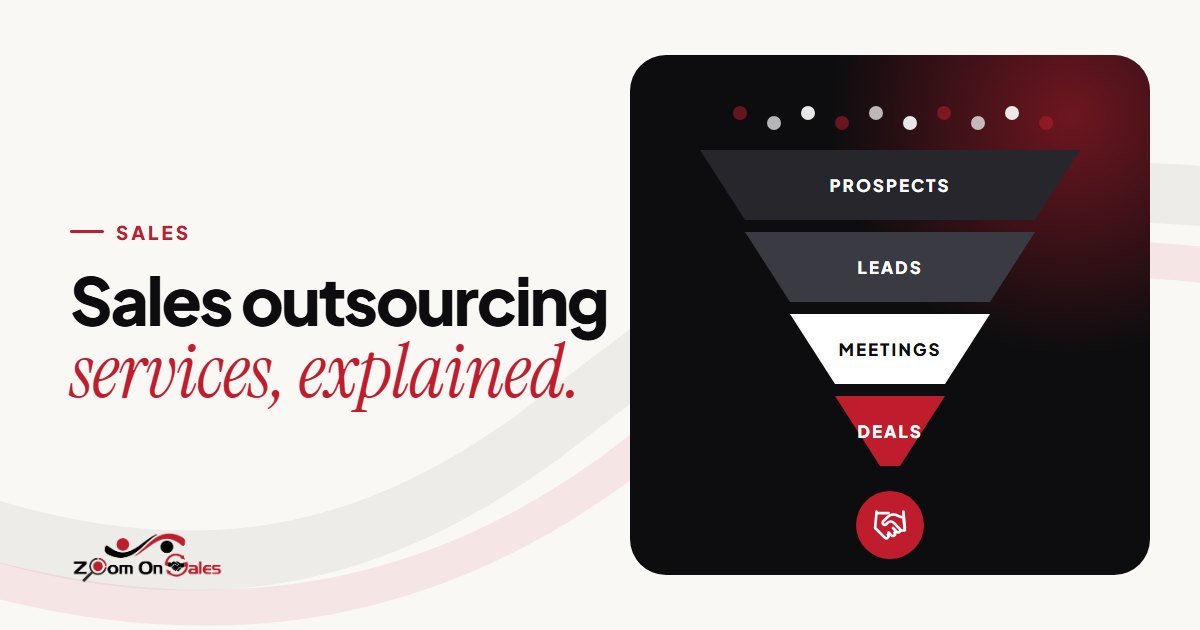
Sales outsourcing means hiring an external company or team to perform sales activities on your behalf. It ranges from a single function, such as booking meetings, to the entire process from first contact to signed contract.
Done well, an outsourced sales team works like an extension of your company. They represent your brand, follow an agreed process, use your messaging and report results back to you. Done badly, it becomes a black box that burns budget and damages your reputation with prospects. The difference is almost always in the setup and management, which we cover below.
What sales outsourcing services can include
Most providers offer some combination of the following stages of the sales process:
- Sales strategy: defining the ideal customer profile, value proposition, pricing approach and sales process.
- Prospecting and lead generation: researching target accounts, finding decision-makers and building lead lists.
- Outreach and appointment setting: cold email, phone and social selling to start conversations and book qualified meetings.
- Discovery, demos and proposals: understanding the prospect's needs and presenting the right solution.
- Negotiation and closing: handling objections, agreeing terms and getting the deal signed.
- After-sales and retention: onboarding, account management, upselling and keeping customers happy.
- Sales training: coaching your in-house team so the skills stay in the business.
The main sales outsourcing models
1. Full-cycle outsourced sales team
The provider handles everything from prospecting to closing. This suits companies that have no sales function yet, or that are entering a new market and want to move quickly without hiring locally.
2. Outsourced lead generation or SDR team
The provider fills the top of the funnel: researching, reaching out and booking meetings, which your own team or founders then take forward. This is common when founders are good at closing but have no time to prospect.
3. Fractional sales leadership
An experienced sales leader works with you part-time to design the process, set targets, hire and manage reps. This fits businesses that have some salespeople but no one to build the system around them.
4. Sales training and enablement
Instead of selling for you, the provider trains your team in prospecting, discovery, objection handling and closing, and helps you build playbooks and materials. The capability stays in-house.
An outside team handles everything from first contact to signed deal.
No sales team yetThey fill your calendar with qualified meetings; you close.
Founders close, no time to prospectA part-time sales leader builds the process, targets and team.
Reps but no systemYour own people learn to prospect, run discovery and close.
Keep skills in-houseMany businesses combine models, for example an outsourced team that sells while also training the in-house people who will eventually take over.
Pros and cons of outsourcing sales
+Advantages
- Faster start: an experienced team can begin selling without a long hiring process.
- Access to sales skills, process and tools you may not have in-house.
- Flexible: easier to scale up, scale down or test a new market.
- Fresh perspective on your offer, messaging and pricing.
−Trade-offs
- Less direct control over day-to-day activity than with your own employees.
- The team needs time to learn your product, market and customers.
- Customer knowledge can leave with the provider unless you capture it in your CRM.
- A poor provider can harm your brand with aggressive or generic outreach.
When does it make sense to outsource sales?
Outsourcing tends to work well in these situations:
- You are founder-led and stretched. The founders are closing deals but have no time to generate new opportunities.
- You are testing a new market or product. You want real sales conversations before committing to permanent hires.
- You need to start selling now. Recruiting and ramping an in-house team would take longer than your runway allows.
- Your team lacks a process. You have salespeople but inconsistent results, and need structure, training and a playbook.
It is usually a weaker fit when you have not yet confirmed that anyone wants the product, because no sales team can sell a product the market does not need. In that case, start with validating the idea and building an MVP.
How to choose a sales outsourcing partner
Ask these questions before you sign:
- Do they understand your market? Ask how they would approach your specific industry, buyers and sales cycle, not just what they have done in general.
- What exactly will they do? Get the scope in writing: activities, channels, volumes and who does what at each stage.
- How will they represent your brand? Review sample messaging and scripts. You should approve anything sent in your name.
- How do they report? Agree on weekly or monthly reporting and access to the CRM, so you can see activity and pipeline yourself.
- How are they paid? Understand retainers, commissions, minimum terms and notice periods. Be wary of guarantees that sound too good to be true.
- Will they make your team stronger? The best partners leave behind a documented process, materials and trained people.
How to set up an outsourced sales team for success
The first weeks decide whether sales outsourcing works. Treat the partner as part of your team:
- Customer profileWho to sell to
- Knowledge handoverProduct, pricing, objections
- Sales processStages and handoffs
- One CRMAll activity in your system
- Weekly feedbackAdjust what you say
- Share a clear ideal customer profile: industries, company sizes, job titles and the problems you solve for them.
- Hand over your knowledge: product training, case examples you are allowed to share, pricing rules and common objections with good answers.
- Agree the sales process: stages, what counts as a qualified lead, and when deals move from their team to yours.
- Use one CRM: all activity and notes should live in your system so the customer knowledge stays with you.
- Hold a regular feedback loop: short weekly calls to review what prospects are saying and adjust messaging.
Metrics to track
Look beyond activity volume and track how prospects move through the funnel:
- number of qualified leads and meetings booked;
- conversion rate from lead to meeting, meeting to proposal, and proposal to closed deal;
- average deal size and length of the sales cycle;
- cost of acquiring a customer compared with the revenue that customer brings in;
- customer retention and repeat purchases after the sale.
How Zoom On Sales approaches sales outsourcing
Our complete sales solutions cover every aspect of the sales process, from prospecting and lead generation to closing deals and building lasting customer relationships, including conversion, after-sales support and client retention. We can run the full sales process for you, or train and support your own sales team, and our strategies are tailored to your industry, target audience and challenges rather than one-size-fits-all.
If you are an early-stage company, sales often goes hand in hand with fundraising: revenue and pipeline are among the strongest things you can show an investor.
Want help with this? Book a free call.
Talk it through with the Zoom On Sales team. Learn more about our Complete Sales Solutions service, or pick a time that suits you.
Schedule a Free Call