
Most startups do not fail because the team could not build the product. They fail because they built something that not enough people wanted, and they found out too late. A minimum viable product (MVP) exists to find that out early and cheaply.
This guide walks through MVP development for startups from the first assumption to the first paying users. It is written for founders who have an idea, limited time and limited money, and who want to spend both on learning rather than guessing.
- An MVP is an experiment: its job is to test your riskiest assumption, not to be a small version of the final product.
- Validate the problem first with interviews, research and simple demand tests, often before writing any code.
- Pick one core job and the cheapest MVP type that can test it, then build in short cycles.
- Decide up front what success looks like, then persevere, pivot or stop based on evidence.
What an MVP is (and what it is not)
The term was popularised by Eric Ries in The Lean Startup: an MVP is the version of a new product that lets a team collect the most validated learning about customers with the least effort. Two words matter in that definition.
- Minimum means you cut everything that does not help you test your main assumption. Settings pages, admin dashboards, dark mode and "nice to have" integrations can almost always wait.
- Viable means it still has to work and solve a real problem for a real person. A broken or confusing product teaches you nothing, because people leave before you learn why.
An MVP is not a cheap version of your final product, and it is not a demo for investors. It is an experiment. The output you care about is not the software; it is the evidence about whether customers want what you are building.
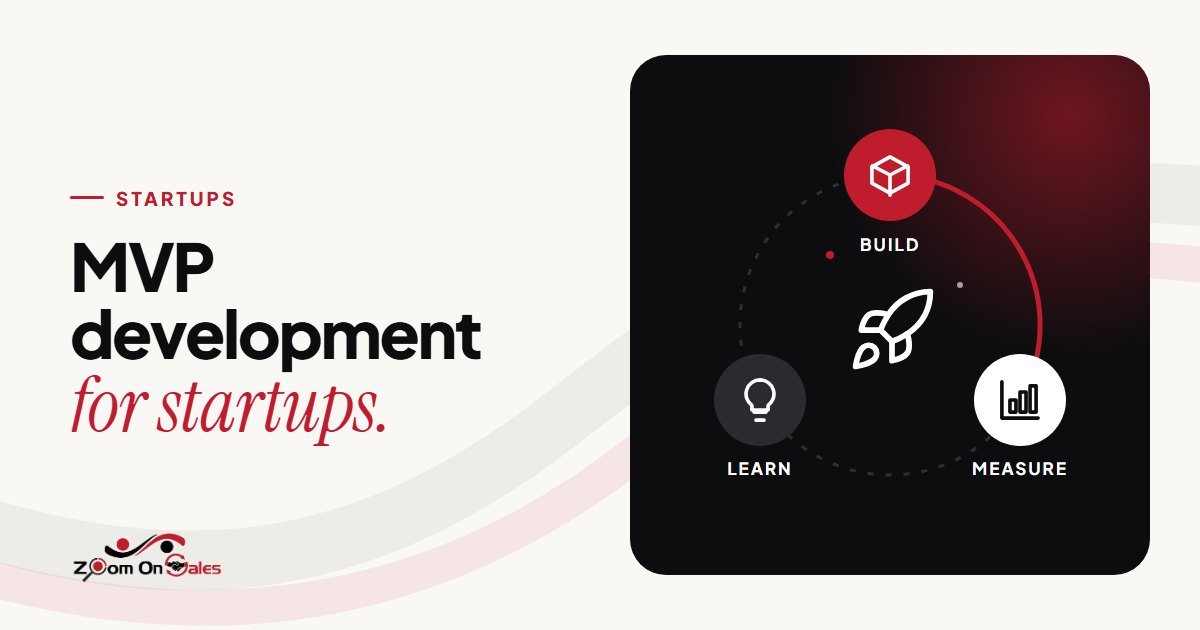
- Build the smallest thing that tests your riskiest assumption.
- Measure what real users actually do with it.
- Learn from the evidence, then decide what to build next.
- 1List your assumptionsProblem, solution, willingness to pay and reach. Find the riskiest one.
- 2Validate the problemInterviews, competitor research and simple demand tests.
- 3Choose the one core jobSort features into must, should, could and won't have.
- 4Pick the MVP typeThe cheapest format that can still test your assumption.
- 5Build in short cyclesUser stories, one- or two-week sprints, analytics from day one.
- 6Launch to early usersPeople who have the problem and will tolerate rough edges.
- 7Measure and decidePersevere, pivot or stop, based on evidence.
Step 1: Write down the assumptions behind your idea
Every startup idea rests on a handful of beliefs. Before you design anything, list them. Typical ones are:
- Problem: a specific group of people has this problem and it hurts enough that they want it solved.
- Solution: our approach solves it better than what they use today (including spreadsheets, agencies or doing nothing).
- Willingness to pay: they will pay for it, and at a price that can sustain a business.
- Reach: we can find and reach these customers at a reasonable cost.
Then ask: which of these, if wrong, kills the business? That is your riskiest assumption, and your MVP should be designed to test it first.
Step 2: Validate the problem before you build
You can test a surprising amount without writing code. Concept validation and market research are not a formality; they shape what the MVP should be.
Customer interviews
Talk to people in your target market about the problem, not your solution. Ask how they deal with it today, what it costs them, what they have tried and what they disliked. Listen for real behaviour ("last month I spent two days on this") rather than polite opinions ("that sounds useful").
Competitor and alternative research
Look at how people solve the problem now: direct competitors, indirect tools and manual workarounds. Read their reviews. Complaints in reviews are often the clearest map of an unmet need.
Demand tests
A simple landing page that explains the offer, with a sign-up, waitlist or pre-order button, can show whether a message gets attention from the right audience. Treat the numbers as directional, not proof, but a page nobody clicks is an early warning worth taking seriously.
Step 3: Choose the one job your MVP must do
The most common MVP mistake is scope creep. A useful exercise is to finish this sentence: "A customer uses our product to ___, and they would be upset if it disappeared." Whatever fills the blank is the core job. Everything else is a candidate for later.
To sort the remaining features, many teams use the MoSCoW method:
- Must have: without it, the core job cannot be done.
- Should have: important, but the product still works without it.
- Could have: nice improvements for later versions.
- Won't have (this time): explicitly out of scope for the MVP.
Be strict. If your "must have" list is longer than a handful of items, you are probably describing version two.
Step 4: Pick the right type of MVP
"MVP" does not have to mean a full software product. Choose the cheapest format that can still test your riskiest assumption.
A page describes the product and asks visitors to sign up or pre-order.
Tests interestYou deliver the service manually and personally to a few customers.
Tests valueThe product looks automated, but people do the work behind the scenes.
Tests the experienceBuilt with visual tools and existing services.
Tests real usageCustom software that does one core job well.
Tests retention & paymentMany successful products started as a concierge or "Wizard of Oz" MVP and only automated the parts that customers proved they valued.
Step 5: Build in short cycles
When you do build software, an agile approach keeps the MVP small and lets you adjust as you learn. In practice that means:
- Turn the core job into user stories, written from the customer's point of view ("As a clinic manager, I want to see tomorrow's bookings in one place").
- Work in short sprints of one or two weeks, each ending with something working that you can show.
- Design for clarity, not decoration. A clean, simple interface is part of "viable". Users should understand what to do without a walkthrough.
- Add basic analytics from day one, so you can see what people actually do, not only what they say.
- Keep a "later" list. Every good idea that is not essential goes there instead of into the current sprint.
Step 6: Launch to the right early users
An MVP launch is not a press event. It is getting the product into the hands of people who have the problem and are willing to tolerate rough edges in exchange for a solution. Good sources of early users include:
- the people you interviewed in Step 2, who already know the problem you are solving;
- your waitlist or landing-page sign-ups;
- online communities and groups where your target customers already talk about the problem;
- direct outreach to a short list of ideal customers, one conversation at a time.
Onboard early users personally where you can. Watching someone use your product for the first time will show you more problems than any internal test.
Step 7: Measure, learn and decide
Decide before launch what result would count as success. Useful signals depend on your model, but often include:
- Activation: do new users complete the core job at least once?
- Retention: do they come back and use it again without being reminded?
- Willingness to pay: do people pay, pre-pay or sign a letter of intent?
- Referral: do users tell colleagues or friends without being asked?
- Qualitative feedback: what words do customers use to describe the value?
Then make a deliberate decision. All three outcomes below are good compared with spending a year building the wrong thing.
The signals are strong. Keep improving the product and start building a repeatable way to sell it.
The problem is real, but your solution, audience or pricing is wrong. Change one thing and test again.
The problem does not matter enough to customers. You saved months and money finding out early.
Common MVP mistakes to avoid
- Building for everyone. A narrow first audience gives clearer feedback and makes it easier to reach people.
- Polishing before validating. Branding, animations and edge cases can wait until you know people want the core product.
- Asking friends for feedback. People who like you are rarely your target customers and tend to be kind rather than honest.
- Measuring vanity numbers. Page views and downloads feel good, but activation, retention and payment tell you whether you have something.
- Not planning the next step. An MVP should feed straight into product development, sales and, if needed, fundraising.
From MVP to a real business
A validated MVP is a starting point, not a finish line. The next steps usually include turning the MVP into a robust, user-friendly product, building a repeatable way to sell it, and in many cases raising money to grow. Evidence from your MVP, such as active users, early revenue and customer feedback, is exactly what makes those next conversations easier, with customers and with investors.
At Zoom On Sales, our idea execution service covers this full path: concept validation and market research, MVP development, product development and design, agile development, project management, and launch and scaling. When you are ready to sell, our complete sales solutions and investor outreach and fundraising services take it from there.
Want help with this? Book a free call.
Talk it through with the Zoom On Sales team. Learn more about our Idea Execution & MVP Development service, or pick a time that suits you.
Schedule a Free Call